This blog is being built along with a blogging framework for the entire Conundrum ecosystem.
This is taking significantly more time than building a simple blogging website, but when this is complete in a couple months, all users will be able to publish their notes as a blog, independent of any specific service, including Fluster.
-- title: On the gravitational nature of time id: onthegravitationalnatureof_time summary: A sample note and a modified model of relativity that partially unifies electromagnetism and gravity. subject: Physics
On The Gravitational Nature Of Time
This is both a sample note representing what Conundrum is capable of, and my presentation of a modified model of relativity that inspired Conundrum. Let me explain...
Late one night in the fall of 2021 I was going over some of Einstein's lectures when I had a realization: His assumptions made far more sense before the observations that gave us the Big Bang. I began to play around with new coordinate transformations when I realized everything... absolutely everything aligns with observation when you apply the only set of transformations that reproduce experiment without requiring the absurd, anti-scientific and pseudo-religious notion that is relativistic simultaneity.
The problem? The only set of coordinate transformations that satisfy experiment that do not require this anti-scientific principle conclude that the Earth is expanding with the rest of the Universe, and that this is the source of the equivalence principle. Avi Loebe couldn't get that past peer review, no matter how many quantities align with observation, so instead I took a different approach. I quit my job, became homeless, and built a few open source academic tools while living on the side of the street in Milwaukee just so I can publish this article along side the documentation.
This isn't another internet fringe theory some lazy, attention starved thought up for clicks... this is a model that should appear like a Rorschach test to any free thinking physicist that is willing to say "I don't know, but the math works". That was the approach we should have had with relativity since 1905. The definition of an event in SR is completely nonsensical and in disagreement with reality itself, and it should have never been accepted as anything other than a mathematical bandaid intended to apply precisely the properties satisfied by this model: is constant in each coordinate system.
While the field equations remain elusive, the model naturally reproduces the geometry of general relativity in a specific frame and does so while producing upwards of a dozen numerical alignments with observation and a resolution to at least 2 of the most pressing issues in physics. This many alignments and the simultaneous resolution of this many paradoxes are not a coincidence, no matter what your geologist friend tells you.
The Lighthouse & The Clock Tower
Let there be two observers, and . Let and agree that should travel at some agreed upon velocity between two arbitrary points in space, and . At place a time keeping device large enough to be visible from where remains at relative rest.
At what time does observe reach , acknowledging the fact that is experiencing no change in kinetic state?
?Nope... is using the same time keeping device as who will measure relativistic dilation. This would mean would need to reach the clock-tower twice. Once at , and once more at .
Can't be a simple Doppler shift to explain away this away as an observational effect either... that equation's already accounted for.
As experiments like Ives-Stillwell have demonstrated, the answer must be in both frames! Keep in mind here that the Ives-Stillwell experiment uses a single, shared event to compare clocks. The elongating of periods between events is not equatable to the duplication of events. This is akin to the 'clock-tower' being aboard the plane while remains on land, and is in fact not contradicted by the fact that the two clocks do not match. In fact, this co-moving clock will be a key piece of the puzzle moving forward as we give an explicit geometry to time and describe our co-motion along this axis.
What is time?
From here most of this derivation is straight-forward for any free thinking physicist, and that's what should hurt the most... this problem was incredibly easy. I knocked out a good portion of it in 4 years while living in my car without internet and most of the time without a power outlet. The model requires no new mathematics (this may change as the field equations come to be), it requires no mysterious curve fitting parameters that nobody ever expects to actually find, and it adds no additional dimensions that don't align with observation. In fact, we're going to remove time as an explicit dimension entirely, reducing space-time to a fluid-like, expanding coordinate system that expands as a function of the modified Lorentz transformations described below.
So what are these transformations? First we'll need to explicitly acknowledge the two primary properties that time occupies:
- A 4th displacement coordinate.
-
A fundamental, driving rate of change.
As you'll see, we'll be able to attribute property to a position along the concurrent density axis that arises from this geometry, and we can satisfy property by attributing motion to the driving rate of change. This should have been obvious the second was described as a function of , but don't worry... we'll fix it.
The Coordinate Transformations
If in both coordinate systems, and is traveling at the agreed upon velocity, then there is only one set of coordinate transformations that satisfy experiment: The lighthouse and the clock-tower are further separated in the coordinate system of , while dilates proportional to spatial density in the coordinate system of .
No magical events that happen twice, no endless temporal paradoxes you have to pretend make sense under certain selective reference frames, and most intriguingly... no time dilation. In fact, is the only constant! This occurs because motion, being a more fundamental property than time is proportional to local coordinate density, giving a velocity that is in some regards equivalent in each reference frame (depending on how is defined). "Time" then dilates between events as those events become further separated as a matter of geometry, not due to a change in any other mysterious quantity we've never directly measured. Sounds a whole lot like cosmic inflation, doesn't it?
Gravity
Well that's grandiose, isn't it? Let's find so I can justify that label. We'll define in a second, because after 5 years of this... I'm going to be as grandiose as I want to be.
For the physicists that haven't taken out a pen and paper already, let's derive the equivalence principle under these transformations:
If we consider that the theoretical spatial dilation might be the source of the equivalence principle, we should consider that may be produced from divergence. Since this divergence would be radial in a simplified single body (of uniform mass density) system, we should find:
This then of course gives:
So what does this evaluate to for Earth?
A little curiosity tells you that's awfullyyyy close to , but it's not... actually follows the relationship:
But this isn't just a unique, Copernican-like relationship.
Our Solar Parameters
Warning: This section looks a bit like number fitting, but hang in there. There's a pattern that arises.
Let's explore this same relationship for our solar parameters. If we simply plug them in we find:
That's a little disappointing if we're expecting 1, but let's consider that this term in equation 5 seems to reproduce using radial gravitational parameters, while Earth is in a rotating frame of reference. If this term reproduces this co-rotating frame of reference, and the Sun being a much larger, more massive body rotates more slowly (about times the rotational period), we might try collapsing this term from .
Likewise, let us consider that in perfectly Machian Universe, this radiating force would be the source of inertial mass following:
Where is the body in question, iterates over all bodies in the system, and is some yet unknown geometric scaling function that will give us the field equations we need to successfully bind electromagnetism with gravity within a decade.
If we then consider that this quantity may act inside of the divergence that yields for masses that are more dominant of their local Machian environment (the Sun, Jupiter, etc.), we find
This gives:
This gives the outline of a single function that describes as oscillating between and as a function of mass and velocity, and just look at the results:
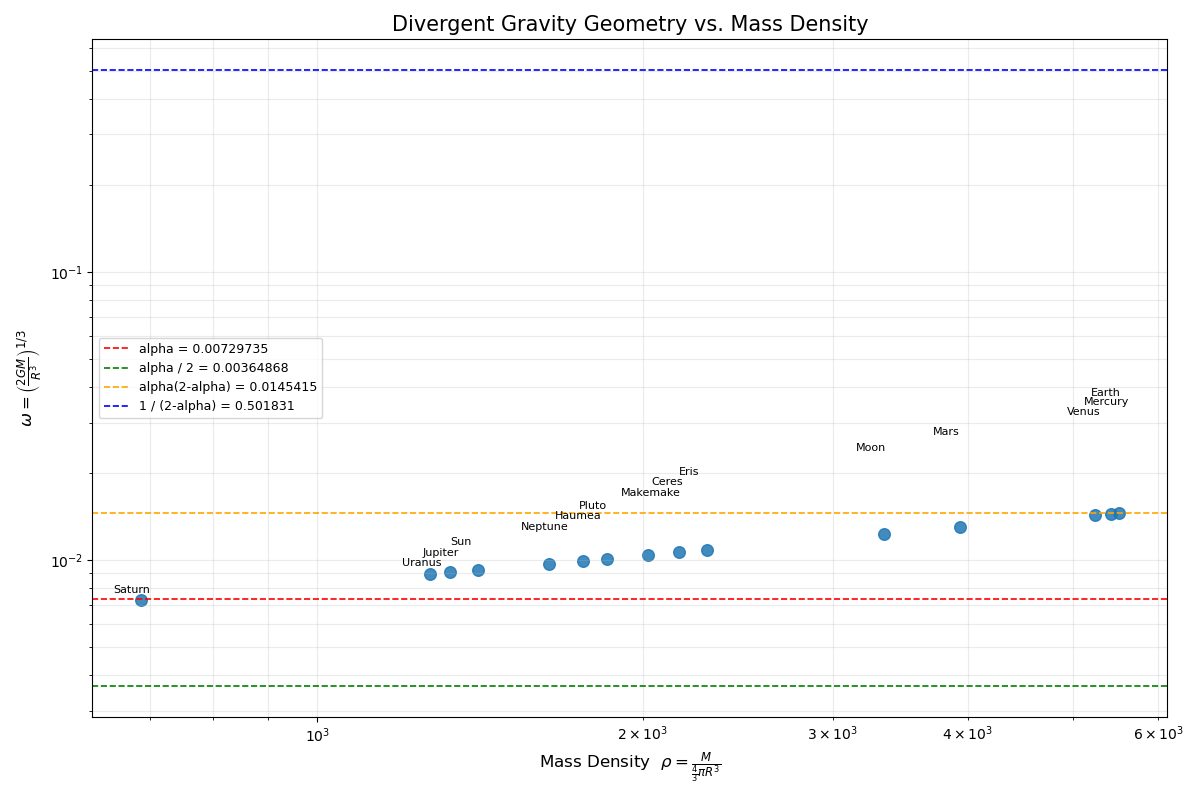
Plugging in the values for Saturn gives or , off by and for Earth... and we've made several apparently successful assumptions about the geometry of the function, reproducing to within for the Sun using those modifications.
The Equivalence Principle
Let's explore the relationship this model shares with the equivalence principle. I'm sure it's obvious for experienced physicists, but there are some hidden gems... keep reading.
First, it's immediately obvious that we can just rewind this geometry to reproduce at Earth's surface. In both cases (electromagnetic/gravitational parameters) we can derive both our kinematic and cosmological velocities2, but let's start with the EM parameters, because there's more to find here.
First, let's swap over to the other side while focusing on an Earth like body (being more on the receiving end of local Machian flux):
If we then cube things as we would to undo the geometry we used to create this mess, we find:
If we integrate as we would to finally produce , we don't get , but rather
Or about units of temporally co-moving charge per kilogram ( units per ) and yes... that's the square root of the Golden Ratio possibly indicating some sort of phase-shift at .
If a physical operation exists such that is swapped over algebraically at , this phase-shift becomes completely reasonable, describing gravitational mass as a completely electromagnetic phenomenon and giving rise to our specific radius. Why ? Some unknown function of and . The same function that gives rise to inertia itself.
Kinematic VelocitySince we're presuming the equivalence principle is induced by motion as described by these modified Lorentz transformations, this quantity should produce under the relationship that these additional terms represent the portion of , where . This then gives:
If we solve for and substitute this quantity in for , we find:
This aligns with our observed velocity relative to the CMB to within (almost precisely a ratio of if you prefer the pre-Plank data).
So far we've derived a set of coordinate transformations that not only satisfy experiment, but do so without any dependence upon time as a physically meaningful quantity. We've then applied these coordinate transformations, and discovered the outlines of a function yielding electromagnetic parameters from gravitational inputs. This alone would be something worthy of further funded study, but we didn't end there. We then discovered that these transformations also produce the golden ratio to an uncanny accuracy, and lastly: That these transformations yield just 1 of the 4 independently derived equations that correctly predict our local velocity we'll have by the end of this article paper.
Next, we'll move on to our gravitational parameters, repeating the same steps and discover that they predict not just our kinematic velocity, but our cosmological velocity as well. We'll then find a pair of equations given from simple high-school trig that reproduces our galactic orbital velocity with only visible mass, and again... the same kinematic velocity (still following the same relationship with the pre-Plank data).
As the last like "probably right" equation, we'll end with is a somewhat speculative but like holy-shit accurate derivation of Earth's rotational velocity, reproducing Earth's polar radius to an error of just over an inch and a cumulative velocity error of roughly a literal crawling pace. It's not a direct mechanical derivation, but more of a 'well I wonder what this electromagnetic equivalent would be now that we have in a temporally co-moving frame?' and bam... our rotational velocity. Is that as good as a mechanical derivation? Of course not, but that's not the same as number fitting. This curiosity based, exploratory approach is almost exactly inline with the way AI would attack a problem like this. This is far more scientific than believing in mathematical definitions that don't match reality, even if many of the observations to this point are post-hoc.3 Somewhere along the way, right around the time physicists became mathematicians the physics community began to believe that curiosity, if outside the bounds of the hypothesis-first scientific method is invalid. With the way this geometry aligns itself with the work of Wyler, with space-time being a sort of hypersphere in derivative form, I think it's long past time the community develops a sense of humility and reinvestigates these possibilities.
Gravitational Parameters
So, by the nature of the equality defined above it's pretty obvious we can do exactly the same operation to reproduce our kinematic velocity here on Earth, but there's an interesting surprise: We actually find our cosmological velocity first! It's not until we explicitly remove time as a physical quantity by defining a set of simple 'time-equivalent' quantities and integrate this temporal dimension that we find our kinematic velocity (still following that relationship with the pre-Plank data interestingly)!
It is this very relationship, the fact that time is this divergence of space that gives rise to the electromagnetic 4-potential where:
Where is uniquely the time component of the 4-vec of current.
Or
Giving
This geometry is already implicit in our equations. It's time to make it explicit and just admit the obvious: The Earth is expanding with the rest of the Universe, and this is the source of the equivalence principle. We're just in a reference frame that's in co-motion along this concurrent density axis.
Cosmological Velocity From Gravitational Parameters
First, take the derivative of with respect to again...
Then to find a scalar so that we can simply find the product with some length quantity we should take the average of the integral of :
If we then again solve for and substitute in for , we find:
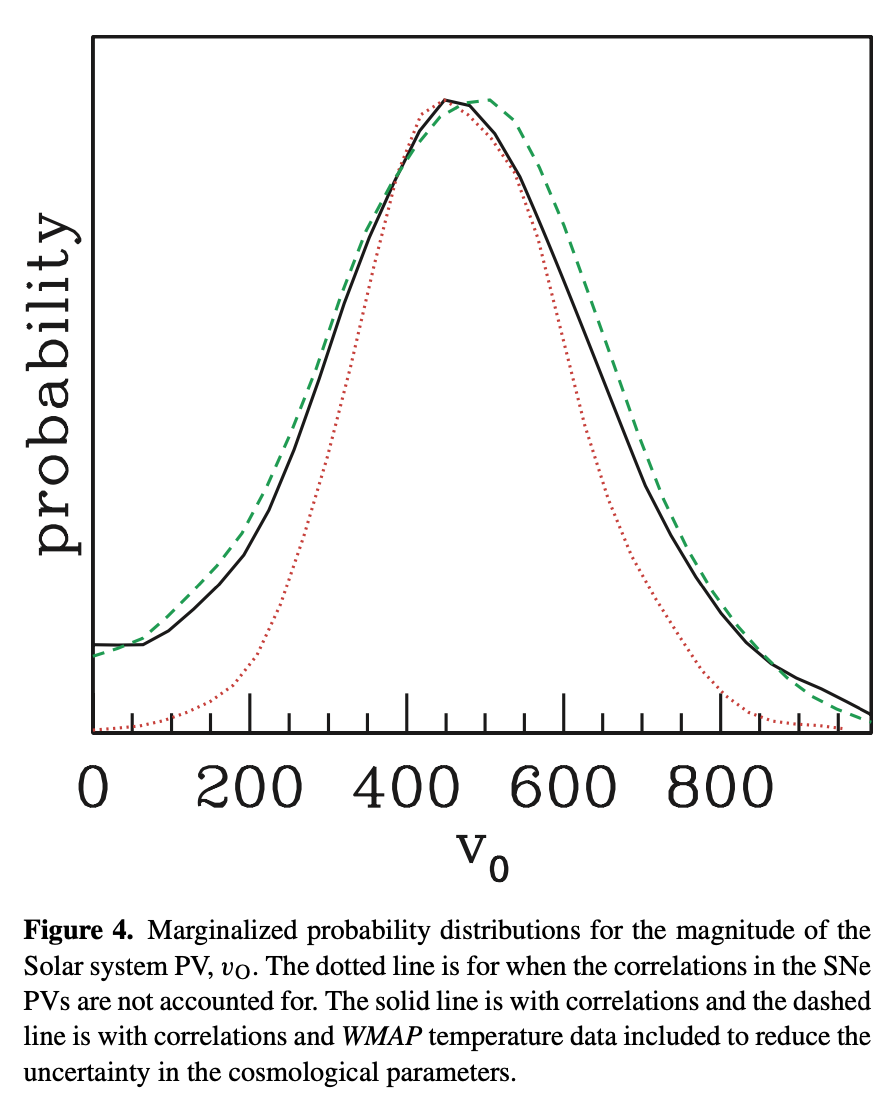
The image on the right was taken from an analysis carried out by Christopher Gordon and his colleagues correlating distant SNe to the CMB.
Here's the thing: This idea that the discrepancy between the CMB and SNe observations indicates some sort of acceleration is only one interpretation of observation, and in my opinion, a flawed one.
Alternatively, if we interpret time as a purely geometric consequence, we can infer that dilates inversely proportional to local coordinate density. As light then travels from some distant star it travels across a fluid like space-time, experiencing the dilation of each according to environment local to that small portion. As we travel through space (our kinematic velocity) the aether represents the coordinate system as it appears in co-motion4, therefore not yielding this same dilation of time between events which is itself secondary to the dilation of space. This aligns itself perfectly with inertia as you would expect it to appear in a Machian Universe, where inertial resistance is induced by the same phenomenon inducing the kinematic dipole.
It is the dilation of this aether that allows the concurrent nature of space-time to occur in much the same way two analog radio channels can communicate simultaneously. If this concurrent nature isn't self evident, think about it: and share time coordinates at the time at which goes in motion. Then they don't, yet didn't disappear into a cloud of pixie dust. If and still exist, yet they don't share temporal coordinates, but they once have... this axis is concurrent. The hot, ultra-dense state of the early Universe still exists concurrently to our own existence, separated only by this density axis.
What can we take a away from this model of synchronicity and chronology? If you really want to kill your own grandfather... he needs to still be alive. If you go back in time some , your grandfather won't be there. Nobody that was there at that density state, where between coordinates is equal to that specific unit length will be there any more, as they've all progressed to the next unit length the second that instant was over. That's what time is!
Imagine two people in Chicago on their way to Milwaukee (pretend for the sake of argument Milwaukee and Chicago are oriented perfectly along the y-axis). If person wants to effect person in some manner, they need to both be at the same position along our y-axis. If was in Chicago, but now they're in Milwaukee, it doesn't matter how quickly you travel back to Chicago... they won't be there. Our temporal dimension behaves in precisely the same way. This borders on being a fundamental property of any independent axis of travel, and in hindsight, our current model of chronology should seem pretty ridiculous.
So what's at some shifted temporal position now? I don't know... I'm not religious in any fundamentalist sense, but if this doesn't bring to mind images of Heaven and Hell as they're typically described... "up" and "down" from a spherical source? Let alone all of the temporal paradoxes this model of synchronicity resolves? I think it's the dimension we describe as life and death. Ghosts, out of body experiences, the sorts of alien technology we appear to be seeing? It may not all be fact, but many such phenomenon become significantly more probable under this temporal geometry.5
Time Equivalent Quantities
Ok, I'm assuming most people that hung in here this long have a baseline understanding of relativity, and I've written this article about 30 times, so I'm going to keep this part super straight-forward.
Time doesn't exist. It's a mathematical tool we've built to help us understand physics in a co-moving frame of reference, but we're ready to move beyond that... to the physics of the "oven's" frame in the common raisin bread analogy. To do this, we need to define time completely as a function of motion.
Imagine some photon, and massive bodies in the immediate vicinity of . As moves some distance , all other bodies move an equivalent where indicates the proportional velocity of body . Space in turn responds to this motion, dilating as a function of local masses and velocities, which we perceive as both cosmic inflation and gravitational acceleration.
What role does time play here? None. We can define some arbitrary point in time where , with indicating the distance between two neighboring coordinates and calculate dilation from this point to define a 4th displacement coordinate, and motion now occupies the most fundamental, driving rate of change.
As in traditional models,
This model uses a velocity that is
When multiplied by our 'time' equivalent , this gives
In the same manner thatLet us then recognize a time equivalent quantity as a dimensionless ratio of distances:
If we consider that time has no driving properties anymore, we should then turn our attention to motion. Since this model proposes that (cosmic inflation and now gravitational acceleration) is time, we can find this time dependent quantity as follows:
Let's then re-examine equation 20 and it's derivation. Since in equation 20 is per unit time, we should then divide by and multiply by our time equivalent quantity from equation 25 .
This gives a quantity that is motion dependent, not time dependent.
And following the rules of integration defined above, we find:
If we substitute this result back into equation 20 and solve for we find:
Using observational ranges of (forgot what paper it's from and I literally can't afford internet. My blunder), this gives us a margin of error of:
Galactic Rotation & Kinematic Velocity
Consider the diagram shown here. A little high school trig gives us:
Solving this equation for gives only one non-zero solution:
Then recall that our escape velocity is derived by integrating kinetic energy radially6... let's use that for . This then gives us:
And you guessed it... solve for , and wait for that mysterious relationship with the pre-Plank data to pop up.
That's an error of about ... again, derived from math an AP high school student can handle.
Let's now consider this trigonometric setup described in equation 29 . If instead of solving for to find the time dilation we set (aka: The co-moving frame) and solve for , we find:
Plugging in some values for Earth gives us:
That's almost precisely our escape velocity, but we're looking for a stable orbit velocity! What the ?!
So what's going on here? We exist in a Machian Universe where inertia is comprised of this radiating force for all other bodies in the system. In our simplified equation that does not take into account the sum of all other bodies providing this resistance, we limit at our escape velocity. Let us test this model by evaluating this equation against a similar system: A planet on an arm of a spiral galaxy.
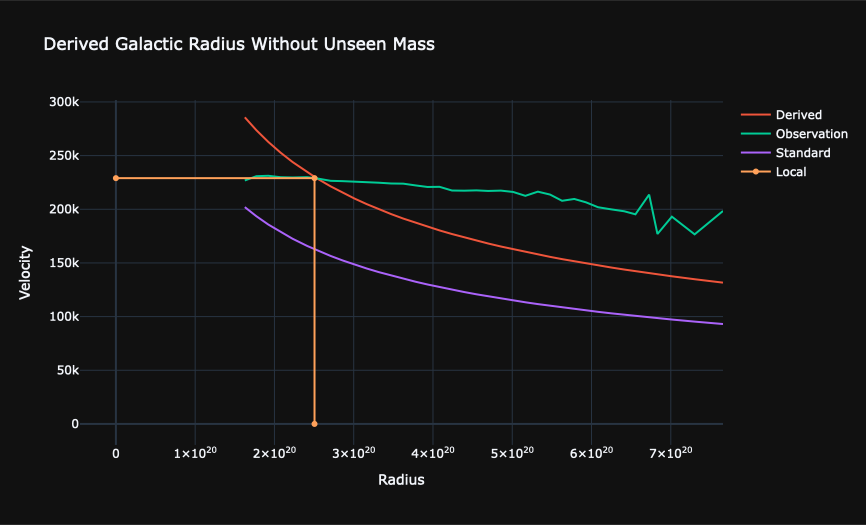
If we plug in our galactic parameters, the value we find falls almost perfectly on top of the work carried out by Anna Eilers and her colleagues (plot above), with only visible mass . Also, keep in mind that I didn't even attempt to integrate mass radially to fit the curve, as I don't believe our models are accurate enough to provide a realistic mass distribution. Integrating mass in this manner would fit the curve of the observational data better, providing more than just a single intersection.
Electric Field Divergence Equivalent
There's still a lot of speculative work I'd like to mention, but this one is kind of the bridge between the "yup, this is kinda obvious in hindsight" stuff above, and the "well, this kinda makes sense" stuff below. The derivation makes a couple assumptions, but the accuracy with which our rotational velocity pops out should at least be reason to investigate further.
To be clear, this derivation doesn't claim to derive our rotational velocity. It simply asks the question: "What physical quantity induces the macroscopic equivalent of electric divergence, now that we know the divergence of the magnetic field in a co-moving frame of reference?" and our rotational velocity is just sitting there.
Let's start by assuming the following identity:
While the lines between electricity and magnetism become even more blurred than in standard relativistic electromagnetism, this identity should hold true if the only difference between and is orientation with respect to an equi-temporal "slice".
Then, since
, but rather is equivalent to the divergence of the coordinate system itself. It only appears to be zero due to our co-motion along this axis.and
Well, remember that term that seems to reproduce a rotating frame of reference? Let's multiply equation 39 by that thing.
That's our rotational velocity on Earth's equator . Off by a total of 0.03 meters (1.18 inches) for a quantity that takes into account a radius the size of Earth's and a period as long as our day. Granted, I don't know why it pops up here, but it should be expected that we find a velocity, as this entire process is now motion dependent, and I mean on a radius the size of Earth's, we're off by an inch ? Number fitting? Kinda... but if this degree of accuracy doesn't cause you to at least wonder, you're just not scientifically minded.
Speculative
Ok, so I'm very confident gravity is velocity dependent. It honestly borders on obvious at this point. This many alignments aren't a coincidence, and they don't require a single event to happen twice. No matter how you define an event mathematically, it's irrelevant if that definition does not match reality. A single, instantaneous event is and always has been a single measurement as the elapsed period approaches zero.
I'm not as confident about some of the other claims I make above, and I want to be as clear as possible about what I'm claiming is an almost certain eventual replacement for GR, and what I'm claiming is simply intriguing.
The relationship with the pre-Plank data? It's interesting that it pops up so reliably, but it's just that... interesting at best.
The fact that dilates proportional to , as do all velocities? This one should be common sense. If time dilates between reference frames, and velocity is time dependent, how can be constant in each frame and between each frame? The two properties become mutually exclusive. must dilate between frames to appear constant in each frame. It's even inherent in the components of , and with both being space dependent.
I Promised You Number Fitting
Well this is an obvious one, but it definitly belongs under number fitting. This would not be universally true, as the term seems to be some spin related component of the function we outlined, but it's apparently pretty accurate for the upper-limit of mass density7.
And less accurrately for our Sun, where the term completely vanishes:
We're off by just over .
And for Saturn, with the lowest mass-density in the system:
We're off by . Not exactly GR, operate a satellite accuracy, but more than enough to demonstrate a pattern.
And these are just the bodies with the properties that really make them somewhat unique in our system, allowing us to validate specific properties of the function itself. This model will give GR accuracy with proper time dedicated to finding these field equations.
Or we can approximate in terms of mass density, , and that same term.
Which of course gives similar solutions, off by the variations in the previous few equations for the other bodies in our system, according to this function we're still trying to piece together. This one's really just moving the previous few equation around to define in terms of and .
And with a little creative algebra and some small angle approximations:
Which aligns with observation to within . Not great, but not bad for a geometric approximation at best.
And then there's the fact that the exact minimum curvature required by this model to be geometrically sound reproduces the distance to the Sun and ...
And then there's this:
Where
Or if approximating as a perfectly circular orbit:
Which if we're really number fitting gives an error approaching our orbital eccentricity, which actually kind of makes sense in this context, but that one's a reach even for me.
Closing Arguments
Um, well there's the Bullet Cluster? That one should be kind of obvious.
Then we've:
- Derived our kinematic velocity from electromagnetic parameters to within
- Found Earth's cumulative, co-moving charge to be , the golden ratio to within
- Found that all major bodies within our solar system fall between the expected ranges, and limit at almost precisely the expected values.
- Gave an explicit mechanism to the equivalence principle, while deriving our cosmological velocity from gravitational parameters.
- Oh yea... we might have solved the crisis in cosmology by describing the SNe/CMB discrepancy in the process. No more dark energy, no more acceleration... just measuring two different things.
- Derived our kinematic velocity from gravitational parameters to within
- Derived a perfect match for our galactic orbital velocity with only visible mass, solving yet another of the most pressing issues in cosmology with high school math.
-
And we defined , the single most unifying quantity in electromagnetism from gravitational parameters to within and .
This model will reproduce GR in the reference frame an observer in co-motion along our temporal dimension, reproducing all of the familiar general relativity equations and mathematics that satellites depend on. It is fundamental to the geometry and to the single modification that we've made to existing models, but a more complete model should be able to define the GR field equations in terms of electromagnetic parameters.
Further Discussion
Ok, I understand that this is a big leap, but with this many numerical alignments, what's more likely: That our 'constants' aren't constant, or that all of these alignments just coincidentally produce a combined average error approximating ? Being an intellectual means weighing probabilities realistically, even when the prospective change is huge. I'm asking the professional physicists out there to evaluate this honestly.
Take the theoretical function giving us our first plot for example. When I wrote this, I was homeless and offline. I had access to only what
scipy
and
astropy
export (mass and radius of the Sun and the Earth basically), but I didn't have access to any other data. I was still able to derive the other limit, without knowing ahead of time that Saturn approximates it almost precisely. That is not number fitting, that is completely analogous to the blinding parameters often used in observation physics.
The evidence for this model is overwhelming, and it does all of this while producing zero known temporal paradoxes of any kind. No killing your grandfather, or the endless cat/train reference frame problems, and no dependence on the dilation of a mysterious substance that nobody has ever directly measured.
Here's the thing:This is a massive change to our understanding of the Universe, which should require a massive amount of evidence, but not an infinite amount, and people in general appear to be very bad at judging this boundary.
While this model produces dramatically new geometries, it does not propose radically new physics, as the entire model is derived from one single modification to SR that's mathematically and geometrically equivalent to existing models in almost every way, and just look at the alignments with observation.
It's time to truly think for yourself. The geometry is difficult to wrap your head around, but the math and physics is entirely consistent with observation... and I mean all observation. Ghosts, UFO's, the afterlife, it is all successfully described by this geometry, albeit in a very incomplete state. Thousands of years of repeated witness accounts of the same experiences are not any more anecdotal than trusting data transmitted from some distance away when we don't completely understand the medium in-between (SNe data). Even the Fermi paradox has a new explanation given this description of our 4th dimension. I'm not saying all of our fanciful myths are based on something real, but at least a significant subset can be successfully attributed to phenomenon regarding this temporal geometry.
The Egyptian myth, the weighing of the soul for example? That appears to be describing a real buoyancy force applied to what we'd call conciousness once it becomes unbound to mass which would likely produce a similar experience as to what people experience when they 'see the light'. Do I have an equation for it? Of course not... the point is that this geometry opens the door to an entirely new axis of exploration, one that appears to be described to primitive people all around the world some time ago.
Perhaps, even, our consciousness has travelled across this dimension before and for this reason this geometry has made its way into mythologies from around the world, but one thing is for certain: it's there.
If that doesn't scream relativity to you, you've allowed the pressures of academia to completely squash your natural sense of curiosity.
It's not just mainstream mythologies either, but faiths and myths from around the world. The Hermetica is practically a physics book, and everyone's familiar with Oppenheimer's love affair with the Hindu texts. I know the geology department will be busy, but maybe we should start to question a bit more of our most ancient archaeological findings too?
What has been considered pseudo-science will be the new frontier of exploration. The study of conciousness, the afterlife, time travel... these all become real possibilities at manageable energy scales with these field equations.
Just think about the potential for the environment when electricity can be harnessed directly from gravity, and gravity can be manipulated by electromagnetism. Think about the change to the environment when we finally bind these two fields, or the new technologies we can develop when we're no longer limited by power production. This is all within reach, in our lifetime, but it requires courage from those that are in a position of power academically; courage to admit that you may have been wrong about something you thought was for certain.
I think of it like this:
If we're a society 10,000 years ago in the middle of a land-bound nation, a person may have never met anyone that has ever seen a body of water they couldn't see across. We're just now discovering the ocean. I don't know how to build a boat, I can't even successfully describe the dynamics of the fluid in an n-body system, but the evidence for the ocean itself is overwhelming, and I can paint a very accurate description of the surface of that ocean.
Final ThoughtThe same way we grappled with the fact that we're not at the center of the Universe, or just how vast the Universe is, we're going to have to grapple with the fact that just as there is no limit on how large a unit of length may be, so too is there no limit on how small it may be. Every time humanity is made to feel more insignificant, we struggle with the logical leap, but the logic is there: The Earth is expanding with the rest of the Universe, and gravitational mass is just curvature induced by co-moving electromagnetic divergence.