On the gravitational nature of time
Some Prerequisite Knowledge
Special Relativity & Time Dilation
First, let's break down the difference between the generalized and specialized theories of relativity. This requires an understanding of a few concepts, but I promise, if you passed high school algebra you can follow the remainder of this note. Some calculus does make an appearance, but the concepts are what matters... not your ability to do the actual math.
Special relativity refers to a set of phenomena that occur due to relative motion and the (kind of) fact that the speed of light is constant in all reference frames. General relativity has to do with the addition of gravity to this model through a theory known as the equivalence principle. The equivalence principle simply put states that there is no measurable difference between being in a gravitational field that accelerates an observer at
Next, let's break down why exactly the speed of light is presumed to be constant so we can later dissect this claim in more detail. Spoiler: It's only half true.
Here,
Where
The fact that both of these constants have units proportional to length will become important soon. Consider taking some time to think about how the geometry of these units relates to the equivalence principle and cosmic inflation.
Time dilation due to relative motion
Einstein was famous for quite a few incredible discoveries, and he deserves credit for even the one which I am attempting to disprove. I am not proposing that his theory was completely wrong. In fact it was far, far closer to the truth than any of his contemporaries, but his insistence on a static Universe (a Universe that is not expanding) early in his career led him to miss the obvious. Throughout the remainder of this note I will attempt to help you see the mistake that he made, but first, we must cover what he did right. The next few paragraphs will walk you through a derivation that follows the derivation provided by Einstein himself to the best of my ability without going into the details of the Maxwell equations, electromagnetism and vector calculus.
Imagine shooting a laser straight up and down from the floor of some spaceship. Thinking of this as being in a spaceship is important for it's lack of gravitational field. This will become incredibly important as we move forward and integrate gravity into this model.
At some height
So that 'time clock' we set up a couple paragraphs ago? Let's set that in motion now, literally. Imagine that we are now in a different spaceship.
All of the physics majors are likely screaming right now, waiting for me to tell you how the entire basis of relativity is that all motion is relative and that there is no such thing as absolute rest or absolute motion, but I'm here to tell you that this is wrong. In fact, this is not the way we treat motion mathematically. In reality, physics carves out a unique niche for gravity, one where all motion is calculated relative to the underlying gravitational field, so that's what we should do here: The spaceship you are in is at rest relative to the local gravitational acceleration. This is equivalent to the free fall frame from the reference frame of a body in co-motion with the 'dough', but a rest frame in the coordinate system of the 'oven' as the 'dough' dilates around the observer.
Now since we're far out in outer space, far away from any stars or planets in this thought experiment we can pretend that gravitational acceleration is zero. This is a core piece of special relativity, but don't worry... we'll add gravity back in the next section.
Now imagine that we are at rest in spaceship
This factor of
And that's it! You've successfully derived time dilation due to relative motion, or did you? That's what modern physics would tell us, although many pompous academics would take issue with the simplistic derivation, but let's break down what we actually discovered here.
First, we have the emission of the photon from the 'laser'. Let's say that this event occurred at
Time dilation is only 1 possible solution here. What we have really discovered is the Euclidean distance between these two events is elongated by an additional factor of
So we are left with two possible solutions:
- Time, a quantity we have never directly measured, and a quantity we aren't even sure exists in any physically meaningful manner dilates.
- Space dilates with time. This coincides perfectly with the notion of cosmic inflation (the expansion that gives us the Big Bang model), and as you will soon see, allows us to collapse cosmic inflation, gravitational acceleration and time itself into a single process as observed from different reference frames. Some units have to change to modify quantities that are proportional to time, making them instead proportional to motion or other processes that are currently proportional to time, but all experiments validating current models of relativity are satisfied due to the
To be clear, what I am proposing is that time doesn't dilate with relative motion. In fact, I'm claiming that time doesn't exist at all, that time exists only as a ratio of distances. In turn, many of the attributes currently attributed to time become attributed to motion, making motion the 4th fundamental rate of change (just as is indicated in
General Relativity & New physics
Beware: Calculus... but not much
So far we've only reviewed what Einstein himself gave us. His brilliance in finding the additional factor of
To dive deeper into the relationship between cosmic inflation, gravitational acceleration and time let us use some common analogies. The most common analogy you're likely to hear for cosmic inflation is that of a loaf of raisin bread or a blueberry muffin. If we imagine a piece of dough placed into an oven, each blueberry will move away from the center of the dough at a velocity that is proportional to the distance that the blueberry was from the center when the dough was placed into the oven. If the berry started further from the center, it will move away from the center faster as all of the dough in between the berry and the center of the dough expands.
This concept gives us our notion of cosmological velocity: Our velocity that takes into account this dilation of space. In this notion of velocity, it is not the motion of the berry through the dough that matters alone, but rather the cumulative motion of both the berry's motion through the dough and the motion of the dough itself.
Our kinematic velocity is different, being made of only the motion through the dough.
Cosmological Velocity
First, let's start with our cosmological velocity. The following is our standard equation for gravity
Above,
If we then take the derivative (break things into really, really small pieces) of this equation with respect to radius1 we find
Above,
We're getting closer, but as
The average of this integral gives us:
This means that we can now solve
And since
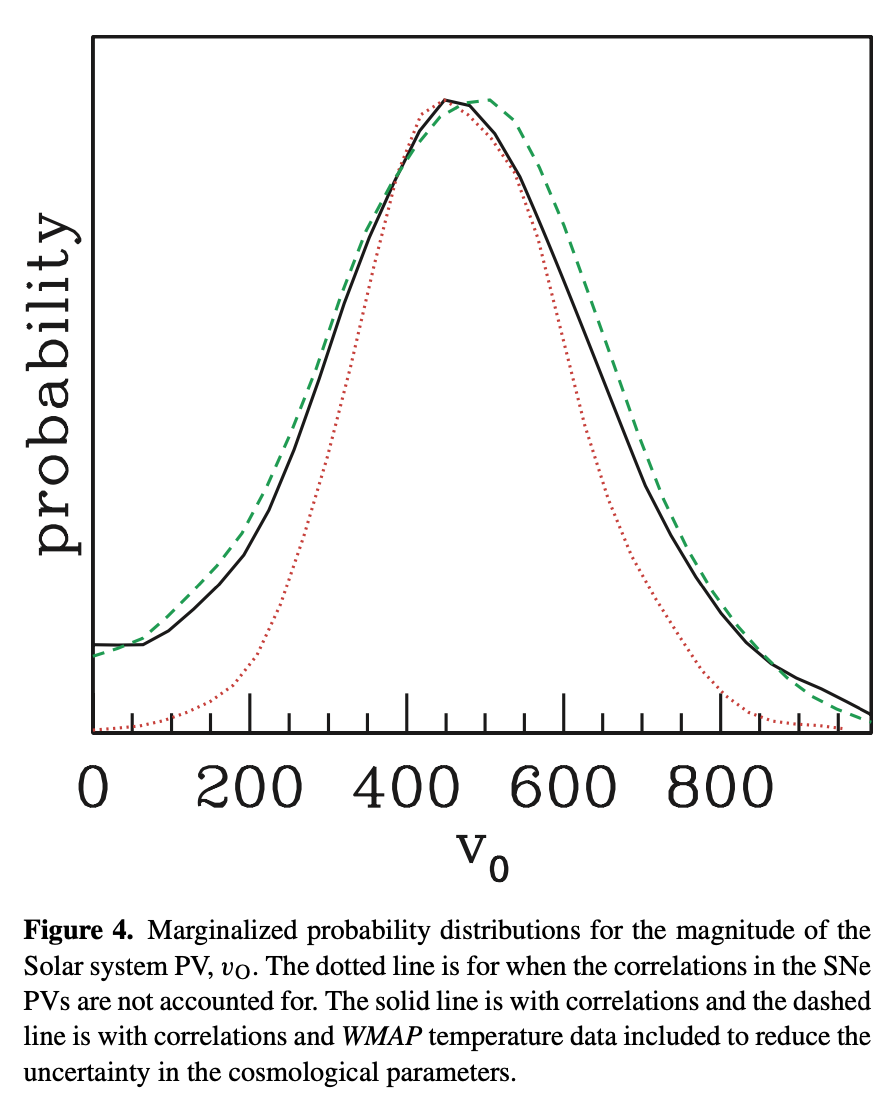
The above value falls almost perfectly on top of probability curves found through direct observation, but we're not done! We can derive our kinematic velocity too.
Kinematic Velocity
Before we dive into the derivation for the kinematic velocity we first need to dig a little deeper into the muffin analogy. Imagine the muffin baking in the oven. If there was some coordinate system in the oven, and a coordinate system in the muffin, there is exactly 1 position within the muffin that does not move relative to the oven as the dough expands, assuming that the 'muffin' is not in motion with respect to the oven along any of the three spatial dimensions. If we expand that analogy to our Universe, we will call that point
This point
This concurrent nature of time should be pretty self evident, even in existing models of relativity and, I argue, has been demonstrated experimentally. Consider two observers,
If we modify the equations above so we instead define
So let us slightly modify the equation for our cosmological velocity to take into account this proportionality to motion, removing the dependence on time. This in turn removes the expansion of the 'dough', giving us our kinematic velocity.
First though, we must define a 'time equivalent' quantity, since we are removing time from the equation.
Time equivalent quantities:
If the 'dough' dilates as a function of the magnitude of a body's motion through the 'dough', and this process when summed over for all bodies within the Universe gives us cosmic inflation, there is no need for some abstract quantity we naively call time. We can define time purely as a ratio of these distances... the distance a body travels through the dough, and a distance that two nearby points diverge from each other. To be more precise, our temporal coordinate is a position along this density axis. This ratio is what gives us the perceived acceleration due to gravity, cosmic inflation, and the perceived passage of time. When
In it's integral (adding up all of the small changes) form, this might look like:
This notation is likely confusing, so let me explain. The denominator indicates the change in displacement integrated over a single unit of "time", giving a measure of length equivalent to the velocity in units of length, while the subscript
To put this in human language, there is no time anymore. There is only motion through the "dough", and motion of the "dough". When each small motion through the "dough" is added up over all of the time in question, we get
Time Derivative Equivalent:
Consider that for
This gives
To put this simply, we can derive an exactly proportional time-equivalent derivative so that we can remove time, and in turn cosmic inflation from the cosmological velocity derivation above.
Applying the time equivalent quantities to find our kinematic velocity:
If
Since
When we then integrate this in the same manner in which we did to find the replacement for
Substituting this back in for
Our observed velocity relative to the CMB (the dough in this model) is approximately
For the math types out there, it is important to note that the integral of
Supportive Observations & Related Phenomena
Pound & Rebka
The Pound-Rebka experiment was an experiment carried out at Harvard in which researchers setup a light clock, not too dissimilar from the one we've setup in our previous thought experiment. The difference (at least the difference that matters) is that they moved the two 'mirrors' apart from each other at a velocity that would perfectly cancel out the Doppler shift induced by gravity. They found a result of
And because
If you're unfamiliar,
And you've likely guessed it, this coincides perfectly with the outcome we would expect in the model in which
Further, since both
Bullet Cluster
The bullet cluster is a pair of galaxy clusters rapidly approaching each other. The extreme relative velocities accompanied by the extreme masses of each galaxy cluster give rise to a phenomenon that current models of relativity can't explain: The mass we see does not align with the gravitational lens.
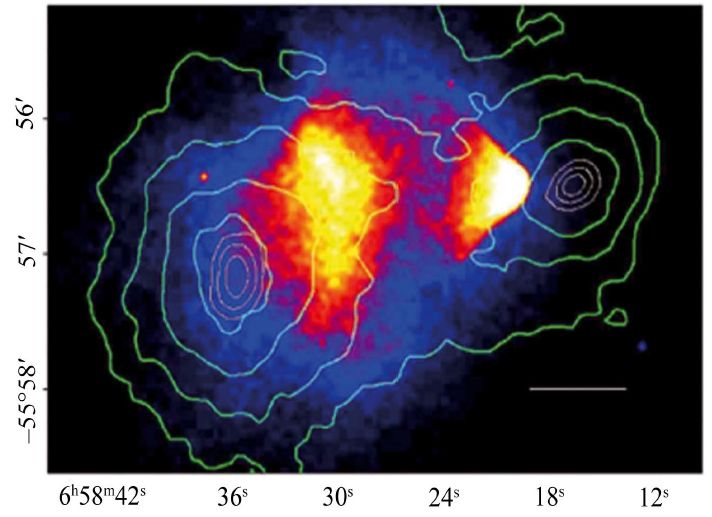
Image hosted by Caltech. As if it's not obvious, they have no affiliation with this app or this model.
This sort of 'washing' effect is precisely what would be expected in a model in which gravity, and in turn the gravitational lens is a function of not mass alone, but of mass and velocity.
Lack of Gravitational Aberration
The apparent lack of gravitational aberration seems to imply that the speed of gravity is infinite, but this can't be the case. If 'time' passes and gravity effects some distant body, it must be that either gravity does not 'move' at all, or that gravity and time are the same thing.
If gravity and time are the same process when observed from the coordinate system of the 'oven',
Super Evolved Galaxies
With the launch of the James Webb Space Telescope in 2021 we've made quite a few incredible observations that require some additional context, if not entirely new physics. One of such discoveries is that of galaxies which appear to be too large to exist at the time at which we observe them.
Because light has to travel to us, the further away an object is the further in the past it was when the light that reaches our eyes or telescope departed that object. This problem of super-evolved galaxies at a time which appears to be too early for our current
Consider that for some unit of pseudo-time
Fine Tuning and the Fermi Paradox
This geometry opens an entirely new concurrent dimension that life may be spread across. It now becomes possible that life exists at some location, separated only by this density axis. If you're the super-natural type, this concurrent density axis might explain certain unexplained phenomena. Everything from ghosts to the propulsion and plausibility of extraterrestrial visitors becomes more likely if an object may exist at shared spatial coordinates, separated only by a density axis coordinate.
This model of concurrency can be extended to preclude that in order to make an object's existence linear, all that is required is a 4-dimensional coordinate for each density state. As space itself dilating gives rise to a sort of higher-order time, our motion along this density axis gives rise to time as we experience it. That is to say that we are in motion along an axis that is in motion itself. This model of concurrency does not explicitly require that an object must follow a linear path in 3-dimensional space. While the temporal axis in this model is not orthogonal, this density axis shares many properties with our 3 spatial coordinates. There is nothing to prohibit an object from traveling backwards in time, so long as the progression of
In other words, as the Universe expands there exists a (assumingly linear, or at least linear down to the Plank scale) density axis with
I will now refer to this progression of
In regards to the super-evolved galaxies described above, there is no reason to infer that our origin at
To summarize, I believe that our position along this proposed density axis exists as a sort of yet unresolved equilibrium solution. This may resolve the fine-tuning paradox while opening the door to a completely new dimension of travel with sufficient technological advancements.
- An object must have a 4-vector for each density state
- This density decreases according to
- An object does not have to exist at
- This is what allows for super-evolved galaxies. There is nothing to exclude a body remaining at a higher density state for a greater number of events, and nothing to require that our position at
- This is what allows for super-evolved galaxies. There is nothing to exclude a body remaining at a higher density state for a greater number of events, and nothing to require that our position at
Machian Inertia
This model in which cosmic inflation is derived from the sum of all gravitational acceleration gives rise to a completely Machian interpretation of inertia. As Newton's laws dictate, every force should be met with it's opposite. If this inflation gives rise to time itself due to an object's motion through the oven's coordinate system, giving an equilibrium solution in the coordinate system of the 'dough', it's opposite should resist a change from this equilibrium state. If Newton's first law is this equilibrium state, any deviation from this state should be resisted by the opposite of the dilation of space.
For body
But
Where
Classical Simultaneity
This one is not so much an experiment, but rather an absolutely ridiculous notion that falls out of current interpretations of special relativity. Resolving this absurdity was perhaps the single greatest motivation in the development of this model. This notion, known as relativistic simultaneity, says that a single, instantaneous event can occur at two different points in time. This just falls out of the math of special relativity, and since most of the math of special relativity has been demonstrated experimentally, it is widely, albeit inexplicably accepted. This is obviously absurd, not only as a matter of physics, but as a matter of math. Through the modifications to special relativity being proposed we can remove this notion, maintaining that all instantaneous events occur at precisely one instant in time.
Discussion
Problems & Shortcomings
First, this model will, by the very nature of the symmetries it shares with existing models of relativity, satisfy all experiments supporting existing models. That is not to say that all the math has been resolved. In the narrow view we can say that all vectors have the same magnitude, some are pointing in the exact opposite direction, but if that is the case the opposite body is moving (space, not the object when it is in gravitational free fall). This gives the same kinematic velocity in both models. Cosmological velocities are a little harder to demonstrate, but by the very symmetries that this model shares with current models, all experiments must be satisfied. That is not to say that the math is easy. In fact, deriving a set of equations for a body in motion through a medium that dilates as a function of that motion, putting space itself in motion is proving to be really, really hard. I know I can do it, but with me being homeless I haven't been able to dedicate time to this model in almost a year as I've worked on releasing Fluster.
Conservation of Energy and Momentum
As the section on Machian inertia implies, inertia is zero when the body is in motion with the 'dough' and the body is in a equilibrium (inertial) state. If the body moves relative to this inertial state the dilation of space around
Variable speed of light
So, have you noticed the inconsistency yet? If the speed of light is constant in each reference frame, how can it possibly be a constant if either space or time dilates? If
The Blackhole Mirage
One of the biggest mysteries in modern physics is how to describe the interior of a blackhole. Current models suggest that the interior of a blackhole is a point of infinite density, a place where even light can't escape. In the model I am proposing, blackholes are nothing more than a mirage in the distance that dissipates as an observer approaches that body's gravitational field, causing the speed of light to dilate proportionally. As only the speed of light through the 'dough' is constant in each reference frame, inversely proportional to the density of the 'dough', the speed of light increases proportionally to local gravitational acceleration. This fits perfectly with what is observed in the Pound & Rebka experiment once our co-motion across the temporal axis is accounted for. Even the curvature of light away from the gravitational source in the gravitational lens follows this pattern.4
The key to moving forward
In short, this model needs to be bound with electromagnetism. The potential outcome of such a unity would change the world on par with the wheel or the discovery of electricity. Through this new description of gravity, cosmic inflation and time we can infer that the divergence of the magnetic field is not 0, but rather equivalent to the determinant of some time dependent 3x3 matrix that describes the dilation of space at that point. In a manner that is similar to the way in which the dilation of space remains hidden apart from the apparent acceleration due to gravity, our co-motion keeps this divergence hidden from us directly. Through this relationship I am confident that gravity and electromagnetism can finally be unified.
There also exists an intriguing coincidence, where if we treat
for a set of local gravitational parameters that occurs on the surface of Earth, where
Treating
To The Physics Students and Professionals
First, thank you for actually reading this, despite what you may think about it. Secondly, yes... I know this is radical. It's a geometry that's hard to wrap your head around, and it leads to several uncomfortable conclusions:
- Gravity is a repulsive force
- Gravity is a function of velocity
- We've had one too many derivatives this whole time
And most significantly, nothing can be proportional to time. The implications of this are huge, but they are not unmanageable or inconsistent with observation. Every quantity we define as being proportional to time can be rewritten as being proportional to something else, even if that just is motion on a relativistic scale. This opens the door to science-fiction level possibilities... imagine every quantity being proportional to a quantity that we can directly influence. Imagine a real, quantifiable geometry to time itself.
The Lighthouse And The Clock-tower - A closing thought experiment
Now that you understand the principles of relativity, lets go through a thought experiment: Let there be two observers,
Surely both observers must agree on the time at which
So if
Footnotes
-
For each small change in the radius, there is a dilation of space equivalent to this function. ↩
-
See the section on the Pound & Rebka results.
-
-
The metric tensor, in the way it is currently applied, appears to describe this motion due to Einstein's reliance on the equivalence principle and the addition of vectors. ↩